
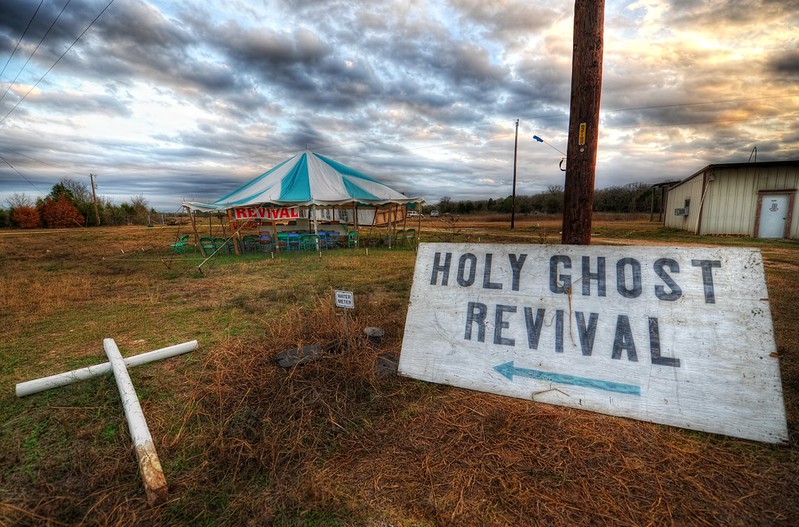
The word Revival is one you have heard and likely heard a lot. We throw it around often: “Our church is having a revival on such and such date, lasting four days;” “God is moving in our (insert name of church or town or parachurch), we are seeing revival in our time;” “What our country needs is a revival;” “We need to be praying for revival:” etc. etc. etc. But do we know what we’re saying when we say “revival”? What is it anyway?
First, it’s important to state that the current obsession with revival is something that has been on the minds of Americans before there was an America. When considering the first large-scale revival in America’s history — the First Great Awakening — we note, then, that they desired and prayed for revival before it ever came. While the breadth of those revivals was surprising, both the desire for revival — and the recognition of its necessity — was something common among Christians. Writes Mark Noll,
Evangelicalism always involved more than the revival of religion but, from the beginning, both revivals and the longing for revival were always central. The kind of religious quickening that proliferated from the mid-1730s was not altogether new, but in frequency, for its publicity and as a replacement for discarded aspects of traditional religion, the evangelical revivals were unusual. They never, however, charted a simple course.[1]
A desire for revival, then, was something written on the Christian conscience well before the beginning of Jonathan Edwards’ ministry in Northampton (the center of the First Great Awakening, in many ways). The nominalism of religion was evident: “What can be recognized is that by the 1720s churchgoing became more of a social formality than a faithful exercise in personal and collective piety.”[2]
The desire for revival was evoked because of the obvious lack of concern for one’s soul that permeated the country. The Christianity of the generation of Americans in the 1730s had been largely forgotten. People cared far more about things of the earth and never attended to their souls. This was clear in the way people lived. By the time Edwards took over the pastorate from his grandfather in Northampton in 1729, New England was in dire straits. As Edwards describes it in his Faithful Narrative,
The greater part seemed to be at that time very insensible of the things of religion, and engaged in other cares and pursuits. Just after my grandfather’s death, it seemed to be a time of extraordinary dulness in religion: licentiousness for some years greatly prevailed among the youth of the town; they were many of them very much addicted to night-walking, and frequenting the tavern, and lewd practices, wherein some, by their example, exceedingly corrupted others.[3]
The decades immediately before 1734 (the first wave of revival in the First Great Awakening) were a “period of decline for institutionalized Christianity, as natives and newcomers shifted their attention to worldly concerns, while others became confused and indecisive when confronting new denominational and sectarian options before them.”[4] Those in Northampton’s ultimate concerns were not the religion of the first generation of American settlers, nor the attendance to one’s soul, but “land and the pursuit of affluence.”[5] As one quipped, “Their children…were given to night walking and tavern haunting; no doubt if they had had drugs, they would have used them.”[6]
So what was it that they were desiring and what did Edwards and the Connecticut River Valley experience in the 1730s and 1740s? Let’s define terms. Revival and its related concept revivalism must be considered and distinguished.
An oft-quoted definition of revival comes from a talk D. M. Lloyd-Jones gave that was included in his book on the Puritans, wherein Lloyd-Jones describes revival as “an experience in the life of the church when the Holy Spirit does an unusual work,” which enlivens, quickens, and awakens “lethargic, sleeping, almost moribund church members,” andconversion of unbelievers.[7] Similarly, Iain Murray, quoting a sermon preached by Solomon Stoddard (Jonathan Edwards’s maternal grandfather and predecessor at his church in Northampton) in 1712, defines revival as “special seasons wherein God doth in a remarkable manner revive religion among his people.”[8]
Revival, then, is an extraordinary, special move of God that is brought down to the church, which has the effect of both reviving a dead church and effecting conversion of unregenerate people. In these conceptions of revival, the move of God is spontaneous, and not planned: revival is “an outpouring of the Holy Spirit, brought about by the intercession of Christ, resulting in a new degree of life in the churches and a widespread movement of grace among the unconverted. It is an extraordinary communication of the Spirit of God, a superabundance of the Spirit’s operations, and enlargement of His manifest power.”[9] Genuine revival, therefore, cannot, strictly speaking, be manufactured, planned, or schemed, but is rather poured out by God on the church by His own initiative, as Gardiner Spring wrote in 1866, “Revivals are always spurious when they are got up by man’s devices and not brought up by the Spirit of God.”[10] This distinction will be important when considering the difference between revival and revivalism.
W. B. Sprague, a contemporary of Charles Finney (seen as the face of the Second Great Awakening), writing during the same time as Finney’s Rochester revivals, sees genuine revival as a return of sleeping Christians to “scriptural knowledge, of vital piety, of practical obedience.”[11] Hence, the term awakening in reference to the since-dubbed First and Second Great Awakenings, seen as a large-scale spiritual awakening of “slumbering” Christians.[12] Sprague goes on to list several marks of revival, which include “an increased zeal and devotedness on the part of God’s people” and the conversion of unbelievers, which might occur gradually.[13] Of much significance is that Sprague also sounds the alarm on false revivals, writing,
Revivals, like every thing else that is good, have their counterfeits; and not unfrequently there is a spurious admixture in those which, on the whole, must be considered genuine. It becomes, therefore, a matter of great importance that we discriminate accurately between the precious and the vile; that we do not mistake a gust of animal passion for the awakening or converting operations of God’s Holy Spirit.[14]
Sprague states that excitements, mere great numbers of professions of faith, and existence of considerable opposition do not a revival make.[15]
Sprague’s comments emphasize why genuine revival needs to be distinguished from revivalism.[16] A shift toward revivalism occurred when seasons of revivals (which were considered spontaneous and brought down by God) became ‘revival meetings,’ which were often planned: “Instead of being ‘surprising’ they might now be even announced in advance, and whereas no one in the previous century had known of ways to secure a revival, a system was no popularised [sic] by ‘revivalists’ which came near to guaranteeing results.”[17] Later, Murray states that revival and revivalism have since been conflated, as if they are one and the same: “But the difference between the two things is real and immense. The phenomenon of true revival retains the same mystery that belongs to the supernaturalism of the New Testament.”[18]Murray notes that true revival is accompanied by supernatural results which are, in an important sense, an unexplainable mystery. “In contrast to this,” he explains,
revivalism contains no real element of mystery: psychological pressure, ‘prayer’ used to create expectancy, predictions of impending results, the personality of the ‘revivalist’ pushed to the fore, the ‘appeal’ – these, and kindred things, are generally enough to account for the extraordinary in its success…Revivalism is marked by the predictable, indeed so much did this become the case that its very promoters found nothing incongruous in announcing beforehand when ‘revivals’ would take place.[19]
In Murray’s estimation, revivalism is fully explainable. Proper methods employed are designed to produce unsurprising results that are not at all mysterious. Perhaps Murray’s most searing indictment of revivalism comes only a page later when he insists that the old generation “spoke of their work as that of seeking ‘the glory of God in the salvation of sinners.’ Now the objective was simply ‘soul-winning.’”[20] Coupled with pragmatism, the underlying goal of salvations (which is, of course, good), with a willingness to do whatever “works,” can result in utilizing any ‘means’ that will achieve the goal. What one is left with is the kind of revivalism Murray describes, and why it must be contrasted with genuine revival.
Here, then, is where we must begin. If we are to talk ‘revival’ we ought to know what it is we are talking about. Historically speaking, revival hasn’t occurred simply because we have calendared it. Nor has revival occurred simply because we see a small-scale response to the gospel or excitements or ‘rededications.’ True revival (again, historically speaking) comes from God through God’s means and has meant both professing Christians giving up their nominalism, repenting, and taking the gospel seriously, and conversions, which alter the town or city in a way that is apparent and long-lasting.
We should desire, pray for, and expect revival, but it is, as all things, on God’s timing. We should also, then, be careful when we proclaim something is a revival too hastily. We should also remember that revival cannot be manufactured by our efforts. It must be brought down by God not brought up by man.
[1] Noll, The Rise of Evangelicalism, 69.
[2] John Howard Smith, The First Great Awakening: Redefining Religion in British America 1725-1775 (London, U.K.: Fairleigh Dickinson University Press, 2015), 53.
[3] Jonathan Edwards, A Faithful Narrative of the Surprising Work of God in the Conversion of Many Hundred Souls in Northampton, and the Neighbouring Towns and Villages of New Hampshire and New England (Boston, MA: James Loring, 1831), 16.
[4] Smith, The First Great Awakening, 51.
[5] Richard F. Lovelace, Dynamics of Spiritual Life: An Evangelical Theology of Renewal, expanded ed. (Downers Grove, IL: InterVarsity Press, 2020), 38.
[6] Lovelace, 38.
[7] D. M. Lloyd-Jones, The Puritans: Their Origins and Successors: Addresses Delivered at the Puritan and Westminster Converses 1959-1978 (Edinburgh, U.K.: Banner of Truth, 1987), 1-2.
[8] Solomon Stoddard, “The Benefit of the Gospel,” in The Efficacy of the Fear of Hell to Restrain Men from Sin (Boston, 1713), quoted in Murray, Revival and Revivalism, xvii.
[9] Iain H. Murray, Pentecost Today? The Biblical Basis for Understanding Revival (Edinburgh, U.K.: Banner of Truth, 1998), 23-24.
[10] Gardiner Spring, Personal Reminiscences of the Life and Times of Gardiner Spring (New York, NY: Charles Scribner & CO., 1866), 217. Emphasis original.
[11] William B. Sprague, Lectures on Revivals of Religion (Glasgow, U.K.: William Collins, 1832), 32.
[12] David W. Bebbington, “Revivals, Revivalism, and the Baptist,” Baptistic Theologies 1, no. 1 (2009): 1.
[13] Sprague, 33-37.
[14] Sprague, 38.
[15] Sprague, 38-41.
[16] In his editor’s note section of the Nine Marks Journal that he oversees, Jonathan Leeman asserts that, “Biblical revivals of this sort depend instrumentally on the ordinary means of grace, but ultimately upon God’s decision and action. Churches will do what they always do: proclaim the gospel, confess their sins, and pray for God to save sinners. Yet God decides to act in a remarkable manner…True revivals are always ‘surprising,’ to borrow a word from Jonathan Edwards.” In Leeman’s view, the First Great Awakening occurred mainly because of ordinary means of grace (prayer, preaching, confession of sin, etc.). See, Jonathan Leeman, “Editor’s Note: Pursuing Revival While Avoiding Revivalism,” 9Marks Journal (January 2019), 3.
[17] Murray, xviii.
[18] Murray, 379.
[19] Murray, 380. Emphasis original.
[20] Murray, 381.

